What is Process Feedback?
Process Feedback offers insight into how students write and do their work.
What is Process Feedback?
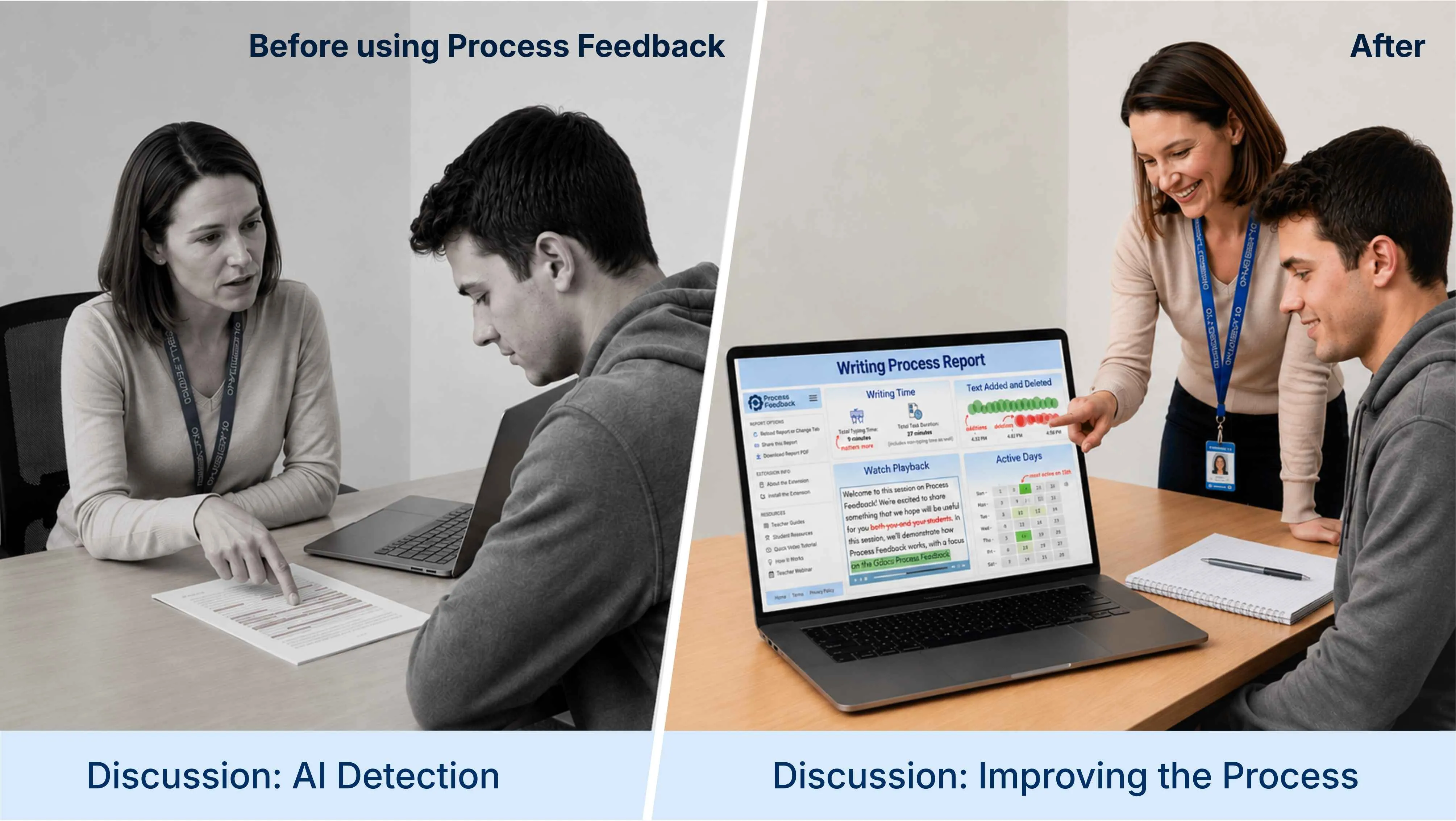
For each document a student writes, Process Feedback produces a writing process report that shows the steps the student took to complete it. Many teachers use Process Feedback in their classrooms to discourage student cheating. While academic integrity is important, Process Feedback's true objective is to show how students actually do their work, so teachers and students can talk about the journey that was taken. Discussing the working process encourages students to become reflective thinkers.
Some key points about Process Feedback:
-
It was started by Associate Professor Dr. Badri Adhikari in the Department of Computer Science at the University of Missouri-St. Louis. -
It is backed by several peer-reviewed research articles, including the first one published in 2023 in Education Sciences. -
It is actively used by 100,000+ students and teachers in 100+ countries. -
It is 100% free for teachers and students, with institutional agreements available with subscriptions. -
It neither promotes nor discourages AI use. It works regardless of a classroom's AI policy.
How it works and where it works
Process Feedback offers several ways to integrate it in a classroom. Students can keep writing where they already write or choose our online editor.
Some ways to generate a writing process report:
-
Write in Google Docs as usual and install our extension -
Install our extension and write in Word Online -
Write in our online writing space -
For computer programming, use our online compiler -
In Canvas, Moodle, Blackboard, D2L, or Schoology, through our LTI integration

Student privacy: sharing the report is optional
In some situations, teachers may not want to ask students to share their writing process. For example, in a graduate-level university course, a professor may not want a graduate student to share that most of their writing happened late at night. Instead, the professor may simply want the student themself to reflect on their working habits. Process Feedback is built with this concern in mind.
Instead of collecting every student's report by default, teachers can:
-
Encourage students to review their own reports privately, before anything is submitted -
Assign reflection prompts and collect the reflections instead of the report itself -
Ask for the report only when a conversation calls for it, not by default
From 'Did you cheat?' to 'How did you do this?'
The most common question about student work has become 'Did you cheat?' It is a question that puts teachers in the role of investigator and students in the role of suspect, and nobody learns much from the exchange.
A writing process report changes the question to 'How did you do this?' Students can show their effort instead of defending it; teachers can see who is struggling while there is still time to help. When AI is allowed and students use it, the conversation can be about reflecting on AI use rather than about whether it was used at all.
Ready for institutional review
When a school, district, college, or university needs a formal deployment, an institutional agreement covers it: a signed Data Privacy Agreement, documentation for procurement review, scheduled audits, deployment support, teacher training, and more.
-
Accessibility report (VPAT) available upon request -
Data security report (HECVAT) available upon request -
Alignment with FERPA and COPPA in the U.S., GDPR in the EU, and APP in Australia -
Support for Data Processing Agreements -
A zero-data-collection tier for extensions and plugins, and a governed tier for LTI integration -
Free one-term pilots
Process Feedback simply reveals the data
- We neither endorse nor oppose students using AI. Our technology simply reveals the steps a student took to complete their work. You decide how to use these insights.
- We believe that a student's working process matters, regardless of whether AI is involved.
- Assigning students to reflect on their working process fosters metacognitive thinking. Feel free to use our sample prompts to guide such a reflection.
- Feedback on the process should be context-specific, which is why we don't provide explicit evaluations. Instead, we make it easier to offer or acquire meaningful process feedback.

See it for yourself
Start with a sample student report to see what the tool actually shows or join one of our monthly teacher webinars.