Academic integrity and AI use concerns
How teachers use writing process reports when they have concerns about AI use
How to tell if a student used AI deceptively
AI detection scores are often wrong, so they are a weak basis for an integrity decision. A writing process report gives you more concrete data. Several sections of the report can help you see whether a student may have used AI in a way your course doesn't allow.
Process Feedback was built mainly to help students reflect on how they write and improve it. Teachers also use the same report when they have an academic integrity concern.
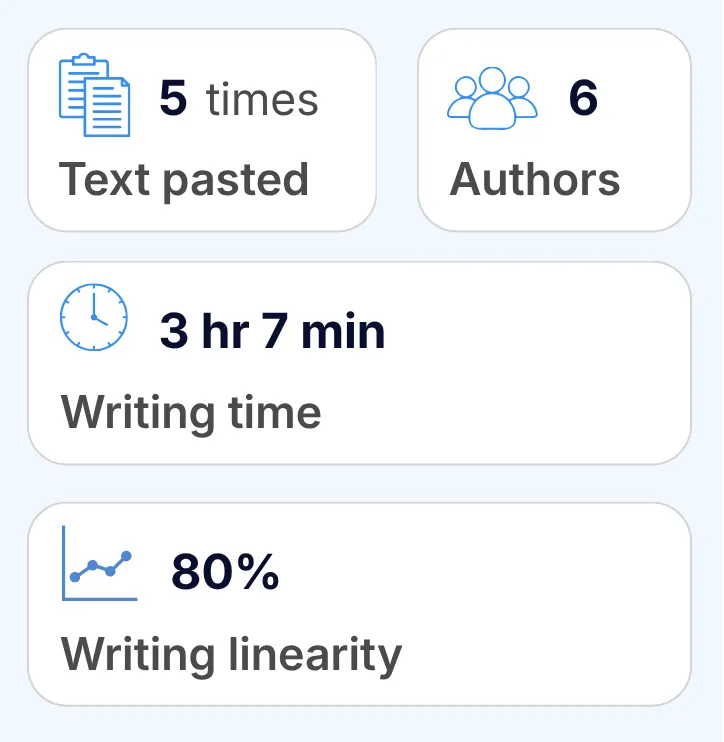
A writing process report shows:
-
Writing linearity -
Writing time and writing sessions -
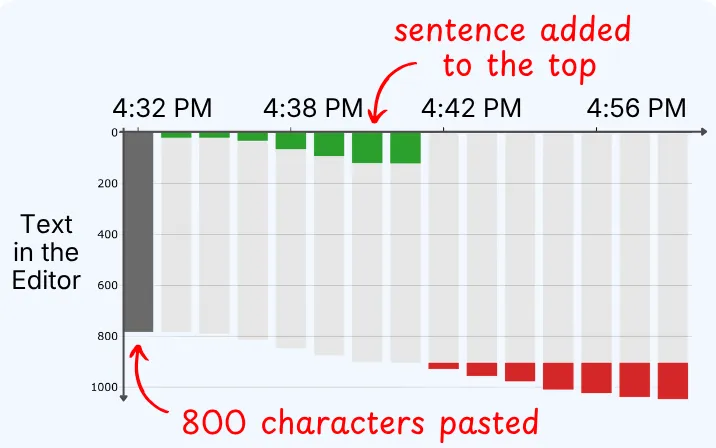
When and where text was pasted, and how much -
A replay of the document as it was written
Supporting your classroom AI policy
Teachers set very different rules about AI, and Process Feedback can support whichever rules you choose. It doesn't decide for you whether AI is allowed. It shows how a piece of writing was done, so you and your students can see whether the policy was followed.
| You are... | Your AI policy | How Process Feedback helps |
|---|---|---|
| Fifth-grade teacher | Students stay away from AI tools | Students write in a writing space on their iPads. The report shows their typing, pauses, and any pasted text. |
| High school teacher | AI is allowed only for brainstorming | The report shows when text was pasted in, so you can see whether AI-written text entered the draft. |
| Journalism professor | Students explore AI and reflect on it | The report shows where AI text entered the work, and students reflect on it with the AI use reflection activity. |
The problem with AI detection scores
AI detectors look only at the finished text and give a percentage. The companies that make them acknowledge false positives, and researchers have raised concerns that they may be biased against English language learners and neurodiverse students (Anna Mills, AI and College Writing).
A percentage is also hard to discuss. If a student wrote the work themselves, there is little they can say in response, and the teacher has nothing specific to point to.
To track the writing process, try using a tool like Process Feedback, a free, educator-developed tool that is less focused on chasing down academic integrity and more focused on helping students understand how they think and work.
Prof. Brent Warner, Irvine Valley College
ASCD Educational Leadership, November 2025 (opens in a new tab)
What a report can and cannot tell you
A writing process report shows what happened in the document. It doesn't give an AI score or decide whether a student cheated. A large paste or a very short writing time is worth a closer look, but there is often an ordinary explanation, such as voice typing or writing a first draft in another app. A student who revises very little may simply never have been taught how to revise.
Teachers use the report and the dashboard to:
-
Decide which submissions to look at more closely -
Have a specific starting point for a conversation with the student -
Inform their own judgment
I've occasionally been mistaken about student AI use. Sometimes, scarce revision and a predilection for GPT-isms like three-part lists are reflective of how students have learned to write.
Chris Gortmaker, Binghamton University
Inside Higher Ed, October 2026 (opens in a new tab)
One way to handle it in a course
It is easier to talk with a student about their writing when they knew the expectations from the start. Here is one approach teachers use:

-
At the start of the term, add a syllabus statement. -
Tell students which assignments allow AI and which don't. -
Ask students to share their writing process report with each assignment, as a link or a PDF. -
When something looks unusual, check the guide to identifying AI use. -
Talk with the student. The reflection prompts can help you ask how the work came together. -
Make your decision using the report along with what you know.
By providing concrete evidence that's meaningful beyond AI detection, it helps move the conversation through accusations and denials and toward talking about the writing itself.
Chris Gortmaker, Binghamton University
Inside Higher Ed, October 2026 (opens in a new tab)
If a student is wrongly accused
A student who is wrongly accused of using AI often has only their word. A writing process report shows the drafting and revising behind their work. Students can create a report for a Google Doc they have already written, even if they didn't have the extension installed while writing, and share it with their teacher.
This tool allowed me to prove that I did not use AI.
★★★★★ 5.0 rating · Jan 2026
Verified Firefox Add-ons Review
What educators are writing
Teachers and researchers have written about looking at the writing process instead of relying on AI detection scores.

| Type: | Blog Post |
|---|---|
| Source: | Prof. Brent Warner |
| Published in: | Educational Leadership, ASCD |
| Affiliation: | Irvine Valley College |
| Published: | November 1, 2025 |

| Type: | Blog Post |
|---|---|
| Source: | Tom Daccord |
| Published in: | Substack |
| Published: | April 24, 2026 |
| Type: | Blog Post |
|---|---|
| Source: | Dr. Joseph Reagle |
| Affiliation: | Associate Professor of Communication Studies, Northeastern University |
| Published: | December 12, 2025 |

| Type: | Podcast |
|---|---|
| Source: | The Higher EdTech Podcast |
| Published: | February 20, 2026 |
When AI is allowed
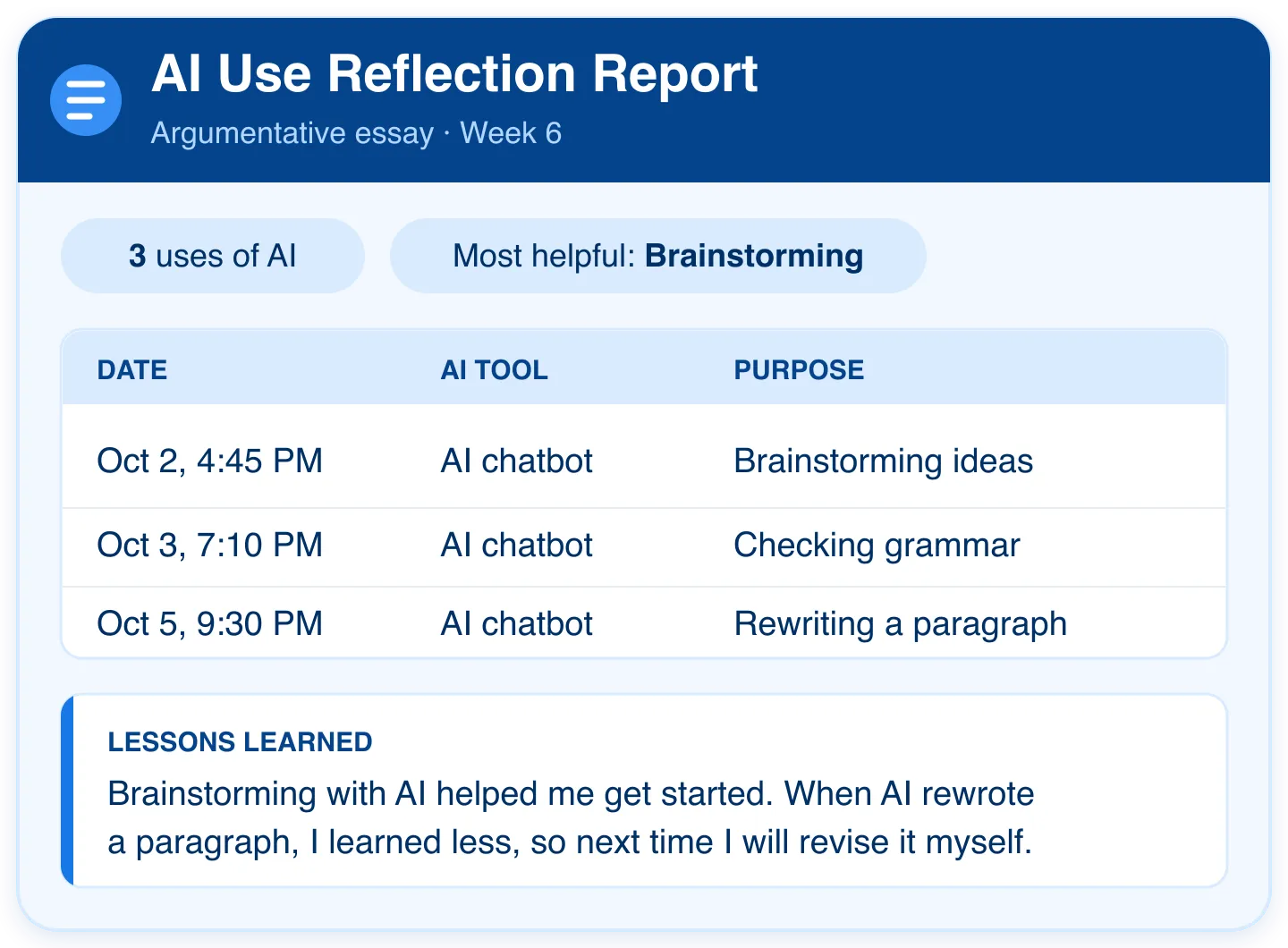
If your course allows AI for some tasks, a report shows when and how a student used it. Students can also look back at whether using AI actually helped them.
-
See at which stages of the work AI was used -
Help students reflect on their AI use -
Read about encouraging responsible AI use

See it in action
See a sample student writing process report, or try it on one of your own Google Docs. It is free for teachers and students.