Why use Process Feedback
Process Feedback works differently from most AI detection and academic integrity tools
The main goal is reflection, not academic integrity
Many teachers first use Process Feedback to discourage cheating. But that is not its main purpose, and neither is discouraging AI use. As explained in a peer-reviewed research paper published in Education Sciences, its main purpose is to give students and teachers data for reflecting on the writing process. Thinking improves not only by doing, but by reflecting on what you did.

Process Feedback:
-
is designed to help students and teachers reflect on how the work was done -
works well even in classes that allow AI use -
does not give a single academic integrity score or label -
is built for students, not for surveillance
We do not learn from experience, we learn from reflecting on experience.
John Dewey
American Educational Reformer
Students learn more when they see how they work
Three ways process data helps students think, plan, and improve.
Learning about how you write can improve you
Since the 1970s, education research has shown that being aware of your process improves critical thinking, metacognition, and self-awareness. Thinking about how you learn helps you plan, monitor, and grow.
Data-driven guided reflection can be powerful
Students rarely get a chance to collect data about their working process. Process Feedback helps students notice when they are most productive, when they take breaks, and how they manage their time across a project.
Feedback on the working process is invaluable
Students don’t often receive process feedback. By reflecting on and sharing their process, students can show their effort, improve their time management, and receive feedback that leads to better results.
Teachers see the work behind the final draft
Process data helps teachers spot who needs support, guide better conversations, and improve their own teaching.
Meaningful insights into struggling students
With writing process reports (or student reflections) shared by students, teachers can receive both detailed and high-level data on students who may be struggling in their course.
Conversations, not accusations
A process report gives teachers and students something concrete to talk through together. There is no score to argue over, just a shared look at how the work came together.
Teachers can reflect on their own teaching too
Seeing how students work can give teachers new insights into their own teaching methods and help them grow more effective.
Why institutions find it easy to adopt
Process Feedback is a research-based learning tool, designed around how students learn. It does not collect student data by default.
- Is it grounded in evidence?
Yes. Process Feedback builds on decades of education research on reflection and metacognition. Its approach is described in a peer-reviewed paper published in Education Sciences.
- Do students need accounts?
No. Students can start using Process Feedback editors right away, with no logins or sign-ups.
- What data does it collect?
None by default. Process Feedback does not collect student writing or behavior data. Data reaches Process Feedback only when a student chooses to share a report.
It’s the opposite of cheating
Process Feedback belongs to the “opposite of cheating” tradition: the argument that the durable answer to academic dishonesty is changing how work is done and discussed, not detecting it after the fact. For the broader argument, see Episode 5 of the Opposite of Cheating Podcast, featuring Anna Mills.
From reflection to reflexivity
Looking back after the work is a start, but the ultimate goal is reflection-in-action: noticing, questioning, and adjusting while the work is happening. When that becomes a habit, students grow into reflexive thinkers who do it without being asked.
-
Reflection-on-action
Looking back at how the work actually happened, with the process report in hand.
“Where did most of my time actually go?”
1 Reflection after the work -
Reflection-in-action
Noticing and adjusting while working. Students can open their process report at any time, not only when the work is done.
“Am I stuck, or just avoiding the hard part?”
2 Reflection during the work - The goal
Reflexivity
Questioning and adjusting becomes part of how a student works, not an exercise they are asked to do.
“What do I do differently now, without being asked?”
3 Reflection over time
Want to go deeper? In this video, Siobhan Maclean explains how reflection develops into reflexivity.
Watch: The journey from reflection towards reflexivityWhen only the final product counts
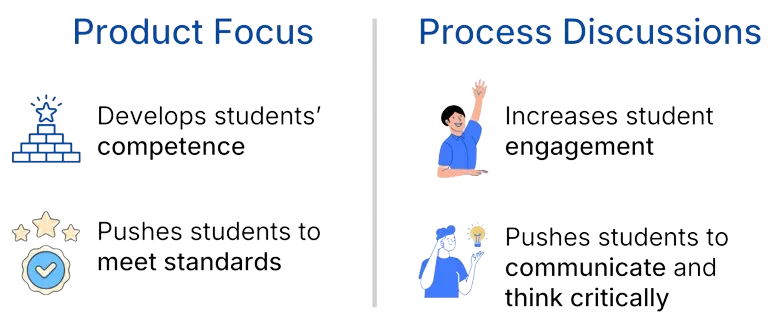
Grades and rubrics usually look at the finished work. That helps students build competence and meet standards. But when no one asks how the work was done, students miss the skills that grow from discussing the process: engagement, communication, and critical thinking.
It works like exercise
A single workout helps right away: it eases a stiff back and clears your head. But the real benefit comes from making it a habit. Process Feedback works the same way.
Process Feedback pays off on two timescales:
-
A writing process report answers an immediate question about how a piece of work was done -
Students who look at their process regularly start noticing patterns and changing how they work
The surprising power of reflection
A little bit of reflection can lead to a lot of benefits for learning and performance. It also gives students room to question what they think they already know, which is often what stands in the way of real learning.
The ability to reflect on what is being written seems to be the essence of the difference between able and not-so-able writers from their initial writing experience onward.
Kathleen Blake Yancey
Reflection in the Writing Classroom