A writing process report is a visual, quantitative timeline of how a student wrote something. It is a measured record of the steps that led to it, not just the finished piece. Instead of judging a document by its final draft alone, a process report shows the drafting, revising, and editing that happened along the way.
Quick summary:
- It replaces guesswork-based AI detection with a record of what actually happened while someone wrote.
- It’s grounded in years of writing process research, not a new idea invented for the AI era.
- It shows patterns like typing rhythm, paste events, and revision timing.
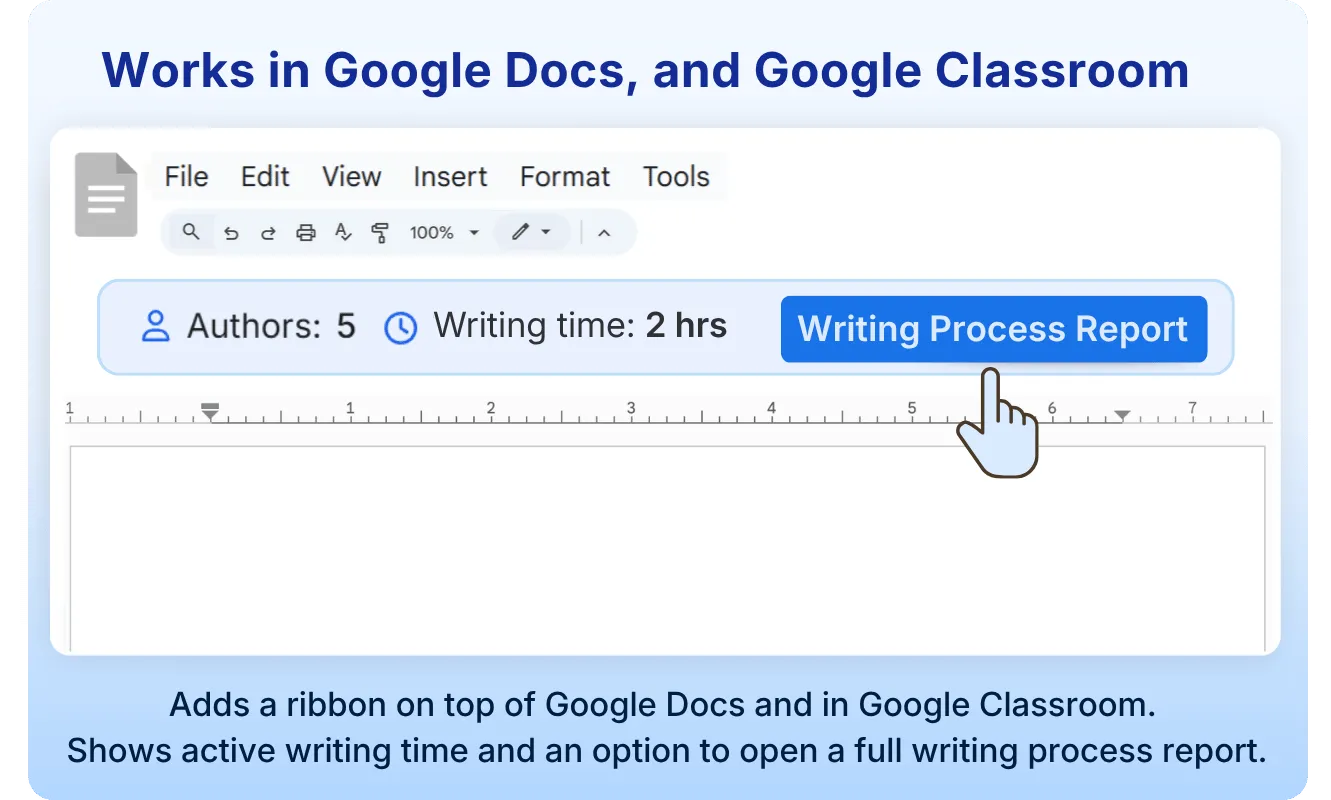
- Free tools like Process Feedback generate one automatically from a document’s existing edit history.
Schools and universities exist to foster independent thinking, preserve knowledge, and cultivate intellectual growth. For decades, teachers have evaluated these qualities by examining a student’s final product: the finished essay or research paper. AI has complicated that model. As classrooms turn to adversarial AI detection tools to verify authorship, many teachers have found themselves caught in a stressful cycle of policing and distrust. A writing process report offers a different path, one that makes student effort visible instead of trying to catch students out.
This guide covers what a process report is, what research backs it, and how it’s used in the modern classroom.
1. What’s actually in a writing process report?
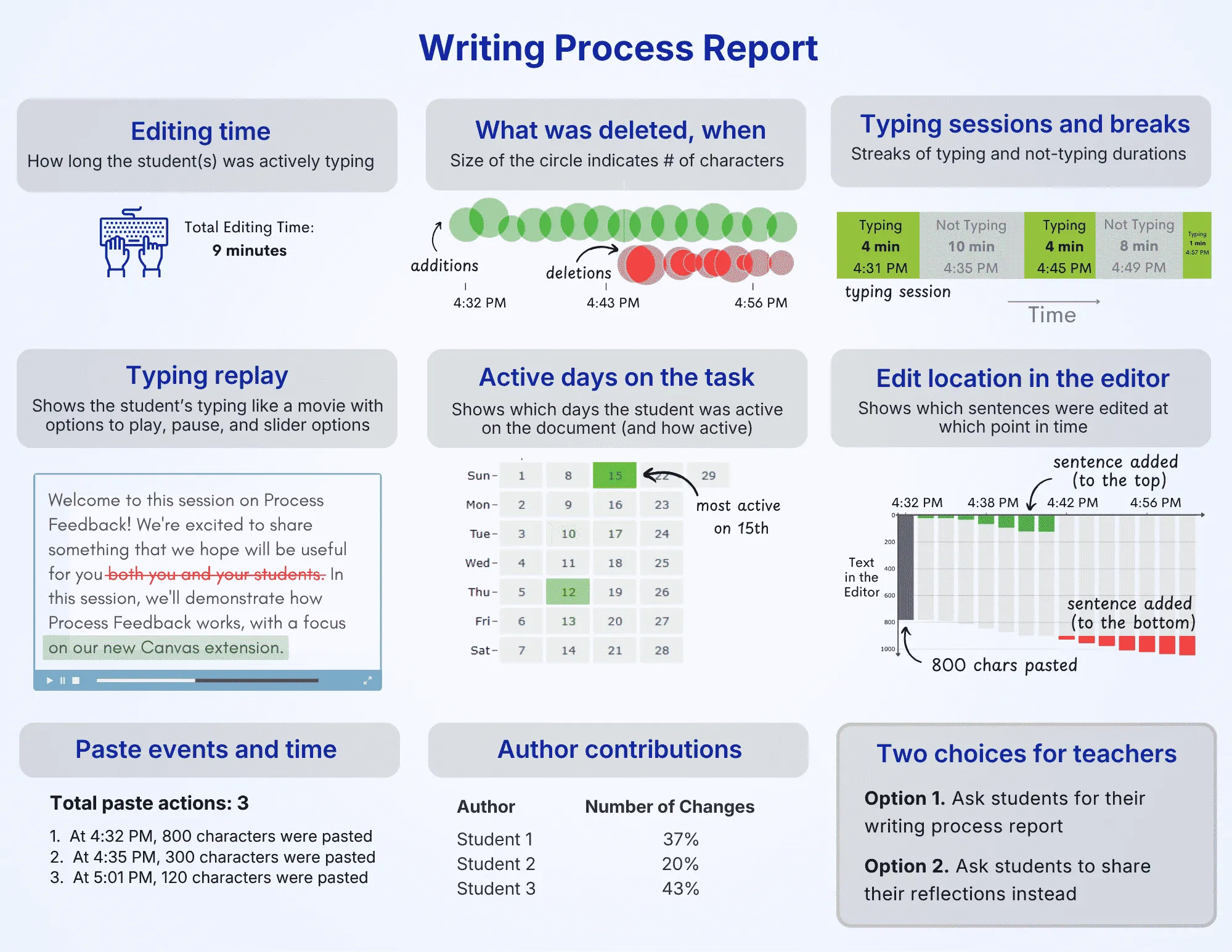
At its core, a writing process report is a simple visual timeline of a student’s writing habits over time. Instead of looking only at the finished essay, it highlights the steps the student took to write it.
Here’s what that timeline typically reveals:
| What it shows | What you’ll actually see |
|---|---|
| Timing and location of edits | A chart mapping when and where in the document changes happened. Whether the piece was built gradually top to bottom, revised out of order, or added in one late burst. |
| Typing rhythm | Typing speed across the session. Steady, human rhythm looks different from unnaturally uniform typing, which can be worth a closer look. |
| Paste events | Any large block of text added all at once, with an estimate of whether it came from inside the document or from an outside source. |
| Session and break patterns | How work was spread across sittings: one long stretch, several short sessions, or work resumed across multiple days. |
| Contributor breakdown | For shared documents, how much each person contributed and when. Useful for group projects. |
| Before and after comparison | A way to compare the document at any two points in time, with additions and deletions highlighted. |
While the concept feels new in the age of generative AI, it’s backed by years of educational research. Researchers Vandermeulen et al., in a 2022 study published in Written Communication, describe feedback that looks beyond the finished product: feedback aimed at the writing strategy itself, so students can carry the skill forward to future work.
In the past, generating this kind of report required specialized lab software, like a tool called Inputlog. Today, browser-based tools like Process Feedback generate one automatically from the edit history that Google Docs and similar platforms already keep. No separate tracking software required.
2. Process vs. policing: a crucial distinction
It’s worth understanding how a true writing process report differs from authorship detection tools like Turnitin or Grammarly’s AI checks. Detection tools are built for security. They try to give a simple yes or no answer to whether a student used AI. A writing process report puts teaching and learning first instead.
The difference comes down to design and tone:
- Legacy plagiarism detection tools focus on where the text came from. Process reports focus on helping students manage their time and improve their writing strategies.
- Detection tools look at the final grammar and style patterns. Process reports look at writing intervals, typing speed, pauses, and how a student deletes or edits text.
- AI detectors are often judgmental, returning stressful percentages like “45% AI Probability.” A process report is neutral. It works like an honest mirror reflecting how the work was done, not a grade or a verdict.
3. Making “invisible labor” visible
Writing is hard mental work. Scholar Donald Murray argued in his influential piece Teach Writing as a Process Not Product that in a healthy writing routine, the bulk of a writer’s time goes to planning and rehearsing, with actual transcription taking up only a small fraction of it.
When a teacher only sees the final draft, the vast majority of a student’s intellectual work remains completely invisible: all of the thinking that happened before a single word was typed.
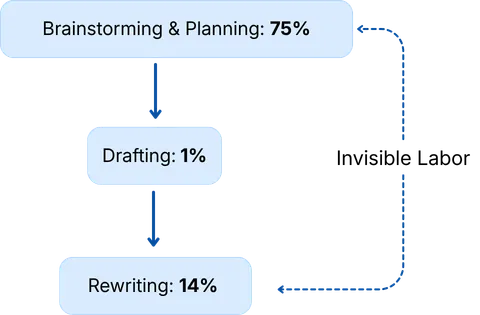
A writing process report brings this hidden effort to light. Research published by Rianne Conijn in Computer Assisted Language Learning found that teachers and students actually want the same thing from writing data:
- Students want feedback that helps them see and fix their own writing habits, like how much time they spend planning versus revising.
- Teachers prefer these meaningful insights over basic automated spelling and grammar corrections.
When students look at their own process reports, they start thinking about how they learn. They stop asking, “Is this an A essay?” and start asking, “Why did I get stuck on the introduction for an hour? How can I plan better next time?“
4. A foundation for reflection and self-awareness
Making effort visible does more than reassure a teacher. When students can see their own process, they begin to understand how they actually write, and that self-awareness, what researchers call metacognition, is where durable improvement starts.
A process report hands the writer fine-grained evidence: where the time went, where the long pauses fell, where writing came in fluent bursts and where it stalled. Rather than only asking whether the final essay was good, a student can ask why the introduction took an hour, or why the argument only clicked on the third sitting. Noticing those patterns is the first step toward planning differently next time. The report becomes a mirror for a student’s thinking, not just their output.
This has grounding in the research. Åsa Wengelin and Victoria Johansson, in their 2023 chapter “Investigating Writing Processes with Keystroke Logging” published in Digital Writing Technologies in Higher Education, note that process data does more than improve the quality of a finished piece. It has pedagogical value in its own right, giving students a way to reflect on how they write and refine their writing strategy for what comes next.
5. What makes a process report useful?
According to a 2023 study by Dr. Badri Adhikari published in Education Sciences, an effective writing process report follows a few core principles:
- It’s objective. A report should never label a student a “cheat” or flag them as a risk. It shows plain, objective data so teachers and students can have an honest conversation and make their own judgments.
- It protects privacy and stays easy to use. Teachers don’t have time for heavy software installations. These tools need to be accessible, free for everyday use, and built to keep student data local rather than selling or scraping it.
- It shows growth over time. An effective report helps track habits across a whole semester, so teachers and departments can see whether students are becoming more engaged and confident writers.
Right now, most tools use rule-based formulas to map out typing habits without using AI to judge the student. That’s likely to change. A safe assistant could eventually analyze a process report to spot helpful patterns on its own, flagging when a student seems to be hitting writing fatigue or struggling with structure, while still leaving the judgment call to a human.
6. Integrity with empathy: a better way to handle AI
Let’s be honest: most teachers look into process reports today because they’re worried about students copy-pasting from ChatGPT.
A process report handles this concern without acting as a digital cop. By surfacing copy-paste events, tracking edits, and displaying typing timelines, shortcuts become visible on their own. No accusation required.
That visibility cuts both ways:
- As researcher Raymond Oenbring points out in the Journal of Writing Analytics, these reports let teachers reward a student’s grit. Hours of active typing and thoughtful rewriting are something a teacher can now see and celebrate, and the same record protects students from false accusations by flawed AI detectors.
- If a report shows a student staring at a blank screen for two hours, or typing and deleting the same sentence over and over, they aren’t cheating. They’re stuck. A teacher can step in with help before frustration pushes that student toward an AI shortcut.
The future of professional work will involve humans collaborating with AI tools, and process reports help teach that responsibly. At the university level, a report can show how a student directs and edits AI output. At the middle and high school levels, it helps ensure students build independent thinking skills first, before leaning on automation.
Frequently asked questions
Is a writing process report the same as an AI detector? No. AI detectors analyze finished text and guess whether it was AI generated, often with a confidence percentage. A writing process report doesn’t guess. It shows the actual editing history: when, where, and how the document changed over time.
Does a process report prove a student didn’t use AI? Not on its own. It shows revision effort, typing patterns, and paste events, which can support a conversation about how a piece was written, but it isn’t a certificate of originality.
Do I need special software to generate one? Not anymore. Tools like Process Feedback build a report automatically from the edit history that Google Docs already keeps, so there’s no separate tracking software to install.
Is student data collected or shared? Reputable tools in this space are built to keep data local and are explicit about not selling or sharing it. Always check a specific tool’s privacy policy before rolling it out to a class.
Conclusion: shifting the conversation
At its heart, a writing process report is a tool for building trust. It replaces a culture of suspicion with an open door for communication.
By shifting the focus away from the margins of a final paper and toward the reality of a student’s workflow, we stop treating writing like a commodity in a transactional model of education. Instead, we get to do what we love most: coach students to become better, more reflective thinkers.